

Bullshit Filters
How to tell when the wool is being pulled over your eyes

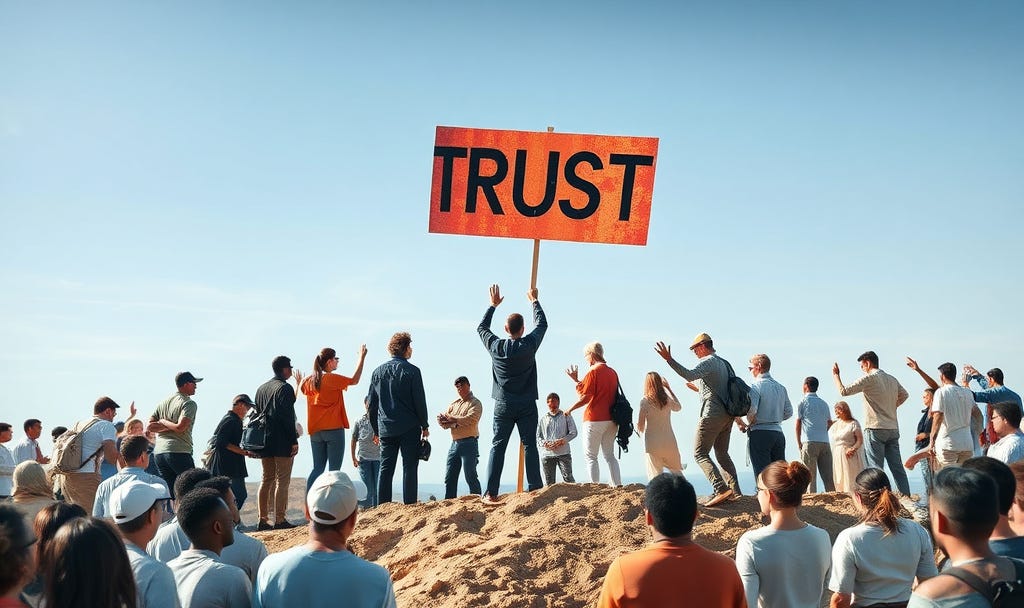
We live in a world based on trust.
We trust that our currencies have value.
We trust our friends and loved ones (hopefully).
We trust that agreements will be followed through on, even if it more often requires lawyers nowadays.
But generally, we struggle to trust information.
In a relatively short amount of time, as a society, there has been a sharp decline in trust.
The rise of fake news, deepfakes, AI, questionable opinion pieces and social media seem to have had a materially negative impact on our ability to trust. But that may just be my experience.
This whole idea of trust sent me down a rabbit hole, trying to identify who and what to trust in this day and age. So this is how Bullshit Filters came to be.
Bullshit
There’s a specific feeling you get reading a marketing piece, a company update, a press release, or a “market outlook” note that says a lot and tells you nothing.
You reach the end and realise you couldn’t repeat a single fact from it and it’s not an accident. That’s a system working exactly as designed, to sound positive without giving anything (good or bad) away.
The philosopher Harry Frankfurt drew a useful distinction back in 1986:
A liar knows the truth and hides it.
A bullshitter doesn’t care what the truth is - they’re only trying to produce an effect. That’s why bullshit is often harder to catch than a lie.
A lie can be checked against the facts. Bullshit is built to survive that check, because it was never really making a factual claim in the first place.
Why a bullshit filter helps
The hardest thing I found when I started out, be it investing, writing or working in financial markets, was knowing when it’s bullshit.
This matters because most of us wade through it daily - marketing, corporate comms, earnings calls, news packaging, LinkedIn thought leadership, political messaging.
So I started trying to come up with identifiers and a checklist to help me filter out the truth from the pile of excrement.
I have found you that don’t need to catch every instance. You just need a small number of reliable tells, that let you downgrade your trust in something quickly, so you can spend your attention on the information that is actually telling you something true.
Here’s the filter system I use, built from what the research actually shows about how bullshit gets constructed and how trained fact-checkers catch it.
1. Vagueness dressed as precision
Watch for words that sound quantified but aren’t: many experts believe, evidence suggests, significant improvement, industry-leading.
Researchers call these weasel words, which are claims that borrow the authority of a fact without committing to one.
London Business School undertook an analysis of (rather boring) corporate sustainability reporting and found a clean split:
Companies that were actually implementing their stated policies used precise, specific, qualified language.
Companies that weren’t implementing used vague, sweeping language stitched together with “and”, presenting broad claims that sound comprehensive but commit to nothing checkable.
Filter question I use: If I ask “compared to what, and how much,” would this sentence survive?
When this pays dividends: If I’m looking at a company report and there is a sentence such as “there is ongoing market difficulty which impacted our revenues” - but nothing specific, then I know that they either don’t know the exact extent of the impact or they do and aren’t telling.
I generally follow this up by checking their 5 closest competitors to see how they’ve been performing and what their reports say. Helps to compare and see if it truly is a market problem or just a company specific issue.
2. Complexity that appears exactly when the news is bad
There’s a well-documented pattern in corporate disclosure called the management obfuscation hypothesis, and it holds up in the data:
Annual reports get harder to read with longer sentences, more syllables and denser jargon, in the same periods a company’s earnings are weak.
When things are going well, companies write plainly, because plain language sells the good news efficiently.
When things are going badly, complexity becomes a tool. It’s not that bad news is inherently harder to explain. It’s that fog buys time before the market fully prices what’s actually being said.
Filter questions: Is this more complicated than the underlying fact requires? Are there underlying facts?

3. Profundity with nothing behind it
In 2015, psychologist Gordon Pennycook ran an experiment where he fed people “correct sentences” built from random buzzwords, such as “wholeness quiets infinite phenomena”, and asked how profound they felt them to be.
A meaningful share of people rated pure nonsense as deep and insightful, simply because it had the rhythm of profundity. The people most likely to be fooled leaned on gut instinct over scrutiny.
The tell isn’t stupidity, it’s the structure. Impressive-sounding language triggers a “this must mean something” reflex before your analytical brain gets a vote.
Filter question: If I strip out or change the impressive words, is there an actual claim left standing?
4. Confidence with no fingerprints on it
Genuine, well-sourced claims usually come with texture - specific numbers, named sources, dates, acknowledged limits.
Deceptive or evasive language tends to go the other way: fewer specifics, more hedging qualifiers, more passive voice that removes the person doing the claiming (”mistakes were made”, “it has been decided”).
I particularly find the use of we to be revealing. “We did our best”, “There was nothing more we could have done”. More often the word is used to dilute the blame over a wider group, rather than an individual, making it harder for bad news to be attributed properly.
Nobody is standing behind the sentence. That absence is the signal, not any single word.
Filter question: If this turned out to be wrong, whose name is attached to it? Are they showing conviction?
5. A source that hasn’t been checked sideways
Stanford’s Sam Wineburg ran a study putting historians, students, and professional fact-checkers in front of the same live websites.
The fact-checkers, who knew the least going in, outperformed everyone.
Their method wasn’t reading deeper into the site.
It was reading out: leaving the page within seconds and opening new tabs to check who’s behind it, who else is citing it, and what independent sources say.
Historians and students got fooled by things that look credible: clean design, official-sounding names, confident tone.
Fact-checkers ignored the packaging and went straight to the network around the claim.
Filter questions: Have I left this page to check it from different sources, or am I judging it from the inside? Am I being led to their answer, rather than finding the answer?
The five-question quick scan
When you’re not sure whether to trust something, run it through these in order. You’ll usually know by question three.
Strip the adjectives: is there a specific, checkable fact left, or just a feeling?
Is this more complicated than the underlying point actually requires?
Does anyone have their name attached to the claim, or is it ownerless?
Would this still sound impressive if I swapped the jargon for plain words?
Have I checked what independent sources say about this, or am I only judging the source by itself?
None of this solves the version of bullshit you’ll meet in everyday conversation - the friend who is overselling a plan, the colleague managing up. That still on you to read in the room (although don’t forget to look for the buzzwords anyways).
What this gives you is a filter for the packaged information kind: the version built by people with time, incentive, and a comms team, designed to survive a casual read.
You won’t catch everything. But you’ll stop being the easiest person in the room to sell to and that’s most of the battle.
Remember these red flags:
1. Vagueness dressed as precision
2. Complexity that appears exactly when the news is bad
3. Profundity with nothing behind it
4. Confidence with no fingerprints on it
5. A source that hasn’t been checked sideways
Outcome
Use this to help you build trust in the information you read and recognising when its a wealth opportunity or a wealth trap.
Disclaimer: This channel is for informational and educational purposes only and does not constitute financial advice. Saving, Investment and Tax rules vary based on location and can change depending on individual circumstances. You should always consult a regulated financial adviser for personalised advice. I have no affiliate links to any recommendation made above and receive no capital incentive for guiding their use.
An amazing reference to what we used to call “bullshit detecting” years ago. This is so on-point and a welcomed read for anyone navigating life these days! Bullshit is everywhere coming from all directions, at times.
In my current business role, I am a full time bullshit detector… my boss and the owner of the business lies constantly and makes gaslighting an art form! But, last week, I ran into an even better example of this “bs-approach” with a gentleman who believed he had the answers for everything despite his lack of data.
We were having a “business meeting,” although I still don’t know why he was even in the room, and every time he spoke, he would announce and explain why he was speaking. It went something like this, “I am going to explain something that is simple but seems complex but I think it’s important to say in this group. I’m not going to tell you how to run your clinic but…” This is the “profundity” tactic you mentioned!!
Like, what I have to say is so profound, I need to introduce it to you before I say it. My response? “If you wouldn’t mind getting to the point, I have another meeting at 5pm.” Then, the question any bullshitter hates… “thank you for sharing your opinion, do you have some outcomes data to support that?”
Man, that really pisses them off! How dare I ask for proof!! Mind you, I’m not asking for them to prove themselves, I’m asking for the data of the “assumption” so that I can make the most informed decision for this healthcare business!
I ask for data so often (because assumptions are CONSTANTLY being thrown my way to get what they want), that the owner has developed a manipulation tactic of shouting out, “that’s data” when she’s expressing an assumption to me. 🤣😂. I’ve gently reminded her, “announcing that something is data, doesn’t make it so.”
The bullshitting is next level, these days!